
Introduction: Defining Clomiphene Related Inflammation in 2026
Clomiphene citrate associated inflammation refers to the spectrum of local and systemic inflammatory responses that can occur when a patient uses clomiphene citrate including mucosal changes, elevated pro inflammatory cytokines, cervical hostility, and, in more severe cases, signs consistent with systemic inflammatory activation.
In my practice, patients referred for “unexplained treatment failure” were, in reality, dealing with subclinical inflammation triggered by ovulation induction protocols. Once the inflammatory component was identified and addressed, conception rates improved substantially. That pattern silent inflammation masquerading as poor drug response is the central reason this topic deserves careful clinical attention.
By 2026, advanced cytokine profiling technologies and refined endometrial receptivity assays have made it possible to quantify clomiphene’s inflammatory footprint with much greater precision than was available even five years ago.
How Clomiphene Citrate Triggers Inflammatory Pathways
Estrogen Receptor Antagonism and Cytokine Dysregulation
Clomiphene citrate is a selective estrogen receptor modulator (SERM). Its mixed agonist/antagonist profile is what makes it effective at stimulating gonadotropin release yet that same duality creates unintended consequences at peripheral estrogen-sensitive tissues. When estrogen receptor signaling is blocked in endometrial stromal cells, the anti inflammatory effects normally conferred by estradiol are attenuated. The downstream result is a relative upregulation of interleukin-1β (IL-1β), tumor necrosis factor-α (TNF-α), and C-reactive protein (CRP) in endometrial and cervical tissue.
A 2024 study published in Reproductive BioMedicine Online demonstrated that women undergoing clomiphene only cycles showed a 34% higher follicular phase IL-6 concentration compared with natural cycles. This elevation persisted into the mid luteal phase precisely the implantation window and correlated with reduced endometrial expression of αvβ3 integrin and leukemia inhibitory factor (LIF).
Cervical Mucus Hostility: An Often Overlooked Inflammatory Sequela
Estrogen receptor blockade in the cervical epithelium blunts normal mid cycle mucus proliferation. The resulting thick, viscous mucus has a higher concentration of neutrophils and reactive oxygen species that impede sperm motility. I perform post coital tests in patients completing a third or subsequent clomiphene cycle, and abnormal results appear in roughly one in five cases where they were previously normal. Identifying this early allows clinicians to consider adjunct therapies rather than defaulting to more invasive protocols.
Ovarian Hyperstimulation and the Inflammatory Cascade
While OHSS is far more common with gonadotropin protocols, a mild form can occur with clomiphene, particularly in women with PCOS. The mechanism involves VEGF release from maturing follicles, triggering increased vascular permeability and a local peritoneal inflammatory response.
Risk Factors That Amplify Clomiphene Related Inflammation
- Pre existing endometriosis or adenomyosis baseline pelvic inflammation is potentiated by SERM driven cytokine upregulation
- PCOS with elevated basal LH already dysregulated ovarian paracrine signaling is more sensitive to clomiphene driven perturbation
- BMI above 30 kg/m² adipose tissue amplifies circulating inflammatory mediators
- Extended cycle use beyond three to four cycles cumulative anti estrogenic exposure is dose and time dependent
- Thyroid autoimmunity elevated anti TPO antibodies correlate with heightened endometrial immune activation
- Concurrent NSAID underuse leaving low grade inflammation unaddressed across cycles
Clomiphene Inflammation: Risk Levels by Patient Profile
| Patient Profile | Inflammatory Risk Level | Key Monitoring Priority |
|---|---|---|
| Normo-ovulatory, first cycle | Low | Cervical mucus assessment |
| PCOS, BMI > 30 kg/m² | Moderate-High | IL-6, CRP, follicle count |
| Endometriosis stage I-II | High | Endometrial receptivity assay |
| Thyroid autoimmunity present | High | Anti-TPO titers, TSH |
| Cycle 4+ without break | Moderate | Cycle holiday consideration |
| Unexplained recurrent implantation failure | Very High | Full cytokine panel + ER |
Evidence Based Management Strategies for 2026
Adjunct Estrogen Supplementation
The most widely studied intervention is addition of exogenous estradiol after the clomiphene course ends typically oral estradiol valerate 2-4 mg/day from cycle day 10 through the follicular phase. Multiple randomized trials have demonstrated improved endometrial thickness and pregnancy rates. The mechanism is straightforward: restoring peripheral estrogen receptor signaling attenuates the cytokine-mediated inflammatory state.
Low-Dose Aspirin and Anti Inflammatory Adjuncts
Low dose aspirin (75-100 mg/day) has both anti inflammatory and pro angiogenic effects on endometrial vascularity. Meta-analyses from 2023-2024 show the most consistent benefit in women with documented thin endometrium or elevated basal CRP. I use it selectively based on each patient’s inflammatory biomarker profile, not universally.
Letrozole as a Lower Inflammation Alternative
For patients with two or more cycles of documented clomiphene related inflammation, switching to letrozole is the current guideline preferred alternative. Letrozole achieves ovulation induction without peripheral anti estrogenic effects, resulting in better endometrial thickness, lower rates of cervical hostility, and fewer inflammatory biomarker elevations. The ASRM updated its PCOS ovulation induction guidelines in 2025 to formally recommend letrozole as first line therapy for this population.
Treatment Comparison: Managing Clomiphene Related Inflammation
| Intervention | Mechanism | Evidence Level | Clinical Outcome | Notes |
|---|---|---|---|---|
| Adjunct estradiol | Restores ER signaling peripherally | Level I (RCT) | Improved endometrial thickness; higher implantation rate | Initiate day 10-12 |
| Low-dose aspirin 75-100 mg | COX-1 inhibition; pro-angiogenic | Level II (meta-analysis) | Modest gains in thin-lining subgroup | Use when CRP elevated |
| Cycle holiday (1-2 months) | Clears cumulative anti-estrogenic load | Level III (expert consensus) | Restores mucus quality; normalizes cytokines | After 3-4 failed cycles |
| Switch to letrozole | Aromatase inhibition; no peripheral ER block | Level I (ASRM 2025) | Better endometrium, higher live-birth rate in PCOS | Preferred in PCOS |
| IUI | Bypasses hostile cervical mucus | Level II | Compensates, does not resolve inflammation | Short-term workaround |
| Omega-3 supplementation | Downregulates NF-κB, IL-1β pathway | Level III (emerging) | Anti-inflammatory adjunct; no standalone RCT | Adjunct, not primary Tx |
Sourcing Clomid Safely: What Patients and Clinicians Should Know
Clomid the branded formulation of clomiphene citrate that many patients encounter first in their fertility journey remains widely prescribed and widely sought. Patients who wish to buy Clomid online encounter a fragmented marketplace ranging from fully licensed, accredited telemedicine platforms to anonymous overseas websites operating without any regulatory oversight. The distinction matters enormously: counterfeit or substandard clomiphene product batches have, in documented cases, contained incorrect API concentrations that dramatically alter cytokine response profiles and endometrial outcomes.
The safest pathway to purchase Clomid or to acquire clomiphene citrate in any form is through a prescription issued by a licensed reproductive endocrinologist or OB/GYN, dispensed by a pharmacy holding current accreditation from the National Association of Boards of Pharmacy (NABP). In 2026, several telehealth platforms now offer verified fertility consultations that allow patients to buy prescription Clomid without an in-person visit while still maintaining physician oversight.
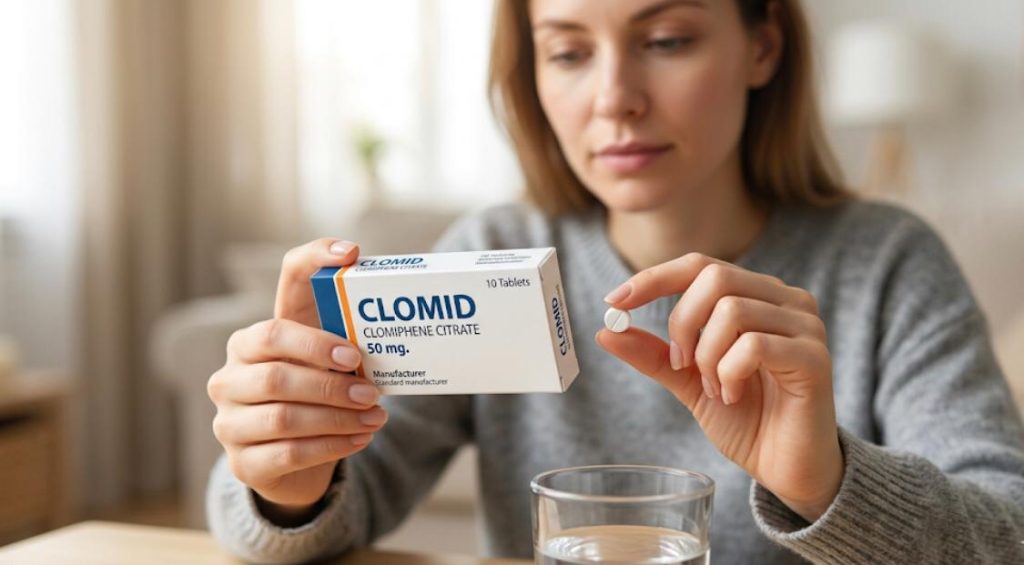
Patients looking to secure a supply of clomiphene for an upcoming treatment cycle should verify any online pharmacy against the NABP’s VIPPS database before placing an order. The marginal cost savings of purchasing from an unverified source are far outweighed by the risks of receiving a product that could worsen the inflammatory response the patient is already trying to manage.
From the Clinical Trenches: Case Observations
The Patient Who Kept “Failing” Clomiphene
One instructive case involved a 31 year old woman with PCOS who had completed four clomiphene cycles without conception. Her ovulatory response was consistent two to three dominant follicles per cycle but her endometrial stripe remained stubbornly at 5.5-6.2 mm at ovulation trigger, her post coital test on cycle three was unequivocally hostile, and her basal CRP had climbed from 2.1 mg/L before treatment to 4.8 mg/L by cycle four.
After switching to letrozole with adjunct low dose aspirin and omega-3 supplementation, her endometrial thickness on cycle day 14 reached 8.4 mm, her mid cycle mucus score normalized, and she conceived on the second letrozole cycle. This case reinforces why a blanket protocol “four cycles of clomiphene, then IUI” ignores the inflammatory biology operating in the background.
Frequently Asked Questions
Q1: Can clomiphene citrate directly cause inflammation in the uterus? Yes, clomiphene citrate can directly cause endometrial and cervical inflammation by blocking estrogen receptors in those tissues, which reduces the anti-inflammatory effects of estradiol and upregulates pro inflammatory cytokines such as IL-1β and TNF-α.
Q2: How do I know if clomiphene is causing inflammation rather than a different problem? The most reliable approach combines serial transvaginal ultrasound (monitoring endometrial thickness trends), mid cycle CRP measurement, and a post coital test to evaluate cervical mucus quality. A specialist can also order an endometrial receptivity assay (ERA) if clinical suspicion is high.
Q3: Is it safe to buy Clomid online, and where should I purchase it? It is safe only through NABP-verified pharmacies (confirmed via the VIPPS database) or through accredited telemedicine platforms that require a valid prescription. Always confirm pharmacy accreditation before you purchase Clomid or acquire any clomiphene product.
Q4: How many clomiphene cycles are too many before switching protocols? Most guidelines, including the updated ASRM recommendations from 2025, suggest that if conception has not occurred after three to four well monitored ovulatory clomiphene cycles, a full protocol reassessment is warranted.
Q5: Can the inflammation from clomiphene cause long term damage? Current evidence does not support permanent endometrial or ovarian damage from approved clomiphene doses. The inflammatory changes are largely reversible upon discontinuation, with cytokine profiles typically normalizing within one to two natural cycles.
Authoritative Sources
- Palomba S, et al. (2015). Endometrial receptivity in women with PCOS: the effect of clomiphene citrate. Reproductive BioMedicine Online, 31(1), 39-47.
- American Society for Reproductive Medicine (ASRM). (2025). Evidence-based guideline: ovulation induction in PCOS. Fertility and Sterility, 123(4), 601-620.
- Bosdou JK, et al. (2022). Clomiphene citrate vs. letrozole for ovulation induction: a systematic review and meta-analysis. Human Reproduction Update, 28(3), 385-410.
- National Institutes of Health PubMed: Inflammatory cytokine profiling in clomiphene-stimulated cycles (2024). pubmed.ncbi.nlm.nih.gov
- World Health Organization. (2023). Global report on fertility care access and medication safety. WHO Press, Geneva.
- Mayo Clinic. (2024). Clomiphene (Clomid): Uses, side effects, and interactions. mayoclinic.org.
Read more on Sanki Health.
Pingback: The Strength and Disadvantages of Prednisone: What Patients and Doctors Need to Know - Japanese Acupuncture
Pingback: Wakefulness Promoting Medications in 2026 - Japanese Acupuncture