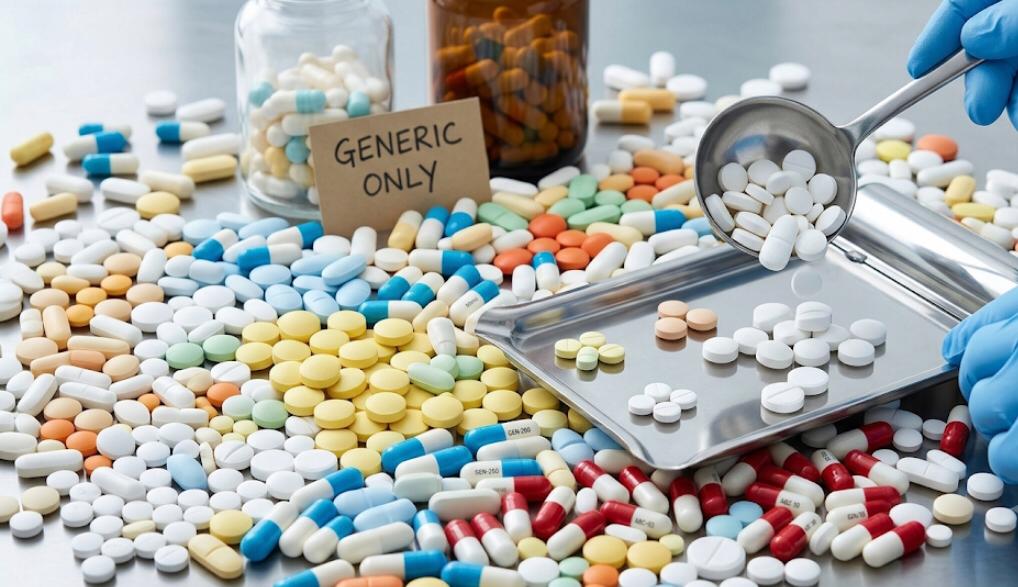
President Donald Trump has announced a major shift in trade policy by introducing new generic drug tariffs, aimed at forcing pharmaceutical companies to relocate manufacturing to the United States.”
President Donald Trump has announced a phased tariff schedule targeting imported generic pharmaceutical products. This major policy shift aims to forcing drug manufacturers to relocate production to the United States. Under the plan, imported generic medicines will continue to enter the American market duty-free under a 0% tariff rate for a two-year transition period. However, beginning in August 2028, a 100% tariff will be levied on imported generic drugs. This penalty rate will escalate to 200% in August 2029 for manufacturers that do not establish domestic production facilities.
The announcement represents a significant expansion of the administration’s broader trade and industrial strategy. While previous pharmaceutical trade measures focused primarily on patented, branded medications, this initiative directly targets the generic sector a market segment responsible for more than 90% of all prescriptions filled across the United States.
Policy Framework and Timeline
The administration’s phased structure creates an explicit runway intended to incentivize capital investment in American manufacturing infrastructure before punitive measures take effect.Under the newly expanded US trade strategy, the administration’s proposed generic drug tariffs could significantly impact the global pharmaceutical supply chain over the coming years.”
The policy is designed around a strict timeline:Economics of Generic Drug Tariffs
Grace Period (0% Tariff): Generic drug imports maintain duty-free entry to give manufacturers time to acquire site locations, construct plants, and secure regulatory clearances.
Phase I Escalation (100% Tariff): A 100% import tax will take effect on generic medicines imported into the U.S. that have not transitioned to domestic production.
Phase II Escalation (200% Tariff): The tariff doubles to 200%, creating a heavy penalty designed to make foreign manufacturing economically unviable for the U.S. market.
The policy framework covers both finished dosage forms (pills, injectables, liquids) and Active Pharmaceutical Ingredients (APIs) the essential raw chemical compounds required to synthesize finished medicines. Tariffs on patented and branded drugs, which were previously negotiated under Section 232 trade frameworks, remain governed by existing agreements.
The Economics of the Generic Pharmaceutical Market
The generic drug industry operates on a high-volume, low-margin business model that differs sharply from the high-margin, patent-protected brand-name market. This economic reality makes the industry particularly sensitive to supply chain changes and trade duties. Because margin compression is severe, generic drug makers historically moved manufacturing to overseas hubs with lower labor costs, fewer environmental permitting hurdles, and subsidized industrial infrastructure. Consequently, domestic production capacity for generic finished products and upstream raw materials has steadily declined over recent decades.
Global Supply Chain Dependencies and Vulnerabilities
Rebuilding a domestic generic manufacturing base presents significant logistical and regulatory challenges. Over the last thirty years, global supply chains have integrated heavily around specialized international manufacturing hubs:
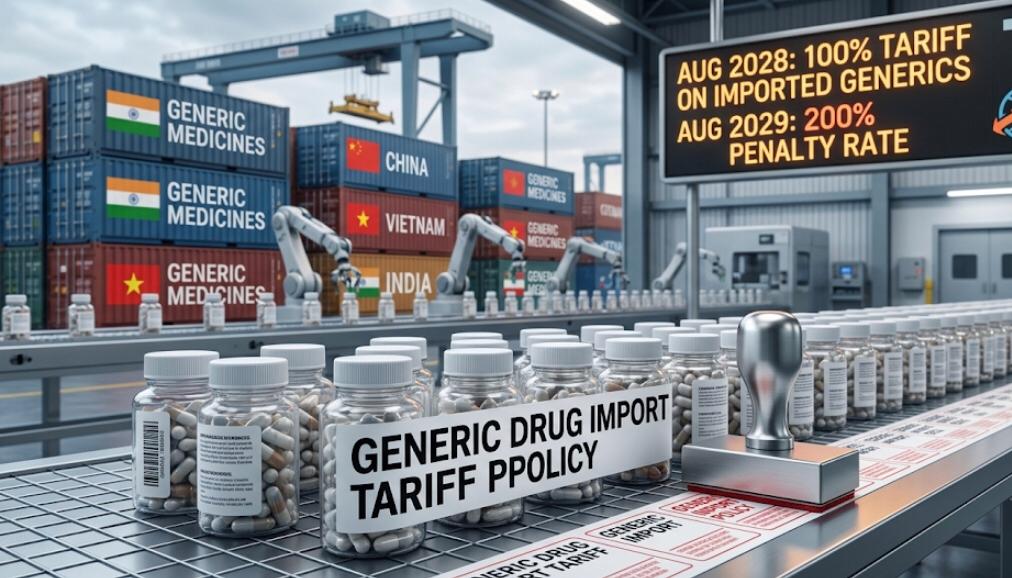
- India as the Primary Finished Goods Supplier: Indian pharmaceutical manufacturers supply nearly half of all generic formulations consumed in the United States, representing approximately $10 billion in annual exports. Key therapeutic areas including generic treatments for hypertension, type-2 diabetes, bacterial infections, and psychiatric care rely heavily on Indian fabrication facilities.
- China as the Upstream API Hub: Even when generic pills are finished in domestic or European facilities, the key starting materials (KSMs) and Active Pharmaceutical Ingredients often originate in China. Essential critical care items, such as basic antibiotics (e.g., amoxicillin) and blood thinners (e.g., heparin), depend heavily on Chinese chemical synthesis.
- The Regulatory and Construction Horizon: Building a commercial-grade, FDA-compliant pharmaceutical manufacturing facility typically requires 3 to 6 years. Companies must acquire land, construct cleanrooms, install specialized equipment, conduct validation batches, and complete rigorous Food and Drug Administration (FDA) inspection and bioequivalence processes before commercial distribution can begin.
Industry analysts emphasize that while a two-year transition period provides an immediate planning window, constructing new plants, training workforce talent, and securing multi-tiered FDA site approvals within 24 months presents a very tight timeline for large-scale operations.
Trade Policy Objectives vs. Healthcare Delivery Risks
The administration frames the tariff plan as a strategic measure to eliminate national security vulnerabilities exposed by reliance on foreign supply chains. Advocates argue that reliant offshore supply chains leave the American public vulnerable to geopolitical disruptions, trade embargoes, and quality control lapses overseas. Conversely, trade associations representing generic manufacturers, such as the Association for Accessible Medicines (AAM), along with public health experts, raise concerns about short-term risks to healthcare costs and supply reliability.
Key Points of Concern:
Short-Term Cost Pressure: If drug manufacturers cannot complete domestic facilities before the 100% and 200% tariffs take effect, import duties could be passed along to health systems, pharmacies, and consumers, increasing out-of-pocket costs for low-cost generic drugs.
Risk of Market Exit and Shortages: Because generic margins are low, paying high tariffs may make certain low-cost drugs unprofitable. Manufacturers might choose to pull essential but low-margin products from the U.S. market altogether, potentially worsening existing generic drug shortages.
Bilateral Trade Negotiations: The two-year transition window may serve as leverage for broader trade negotiations. Similar to previous tariffs on branded pharmaceuticals, foreign nations or major multinational pharmaceutical groups may seek bilateral agreements, trade concessions, or targeted investment exemptions in exchange for lower tariff rates.
Outlook Moving Toward 2028
The generic drug tariff schedule sets up a major transition for the global pharmaceutical sector. Over the two-year grace period ending in July 2028, pharmaceutical companies, international suppliers, and health systems will need to make major strategic choices:
Supply Chain Restructuring: Companies will focus on securing alternative domestic supply networks for APIs and raw ingredients to prevent disruptions when the duties take effect.
Whether this phased tariff structure succeeds in rebuilding American generic drug manufacturing or leads to supply frictions and higher patient costs will depend on how quickly domestic production capacity can be built out before the August 2028 deadline.
Beyond general generic medications, this tariff strategy poses a significant challenge to the supply chain of critical antibiotics. Currently, a vast majority of the active pharmaceutical ingredients (APIs) used to manufacture essential antibiotics are imported from countries like India and China. Imposing heavy tariffs without an immediate domestic manufacturing alternative could lead to severe shortages and price spikes for life-saving antibiotics, directly impacting public health preparedness and clinical treatment across the United States.” Consequently, these trade restrictions could restrict patient access to essential antibiotic therapy, making standard bacterial infections much harder and more expensive to treat.”
Systemic Healthcare Inflation
The ultimate result of this scenario is a permanent structural increase in the cost of U.S. healthcare. While the policy achieves its stated goal shifting pharmaceutical production to the United States it does so by reversing the economic model of the generic drug industry. U.S. patients would have a highly secure supply chain, but the era of cheap, globally sourced generic medications would be permanently close